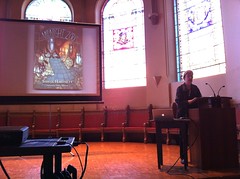
After listening to her lecture online, I must thank
A. Breeze Harper for inspiring me to critically examine my class-privilege as an educated middle-class woman. You can listen to her lecture
here.
A. Breeze Harper
Although I was raised in a predominantly working class immigrant community, I understand now how the issues of economics and race play a part in the rhetoric around veganism and issues of access to healthy food, even in a wealthy nation like Canada. Having reviewed a number of pro-vegan books on this blog so far including
Veganist,
Crazy Sexy Diet,
Skinny Bitch, and
The Kind Diet, the important topics of access, socioeconomics, and race were missing from the discourse.
I grew up the child of Jamaican immigrants. In the late 1990s, when I was about twenty years old after I heard that livestock (natural herbivores) were being fattened with the diseased remains of ground up "dead cows", I tried to be a vegetarian. Living in this community, there were (and still are) no health food stores so I had to do a lot of my shopping downtown and take the subway and bus to transport these goods home. Forget about health information, I did not have access to it like I do now. I did not own a computer and had very little internet access. In essence, I was isolated from other vegans and when I moved away to college with fish and bean allergies (the latter I outgrew), my vegetarianism ended after challenging nine months.
Now, after Harper's work
Sistah Vegan: Black Female Vegans Speak On Food, Identity, Health, and Society, I have an even better understanding of the intersectionality of veganism with identity, politics, and social justice issues like the ones I faced when I just adopted a plant-based diet. Sistah Vegan is refreshing and engaging. It provides something that was lacking in the other books on veganism that I read-- the voices and experiences of Black people and people of colour.
Reading
Sistah Vegan reminded me of the types of discourses I would have in my graduate studies courses where we spoke critically and questioned everything. Through a series of twenty-five thoughtful essays and poems by African American women and one white female ally,
Sistah Vegan expands on the diversity and complexity of the issues that are raised in veganism. It is a very honest, personal and concise dialogue about veganism. By virtue of being Black, these writers not only have a racialized lived experience like me but many of us asked questions about reclaiming our health. As I have been reading other books about factory farming including, most recently,
Farm Sanctuary, I see connections between the horrors of slavery and abuses to slavery.
Sistah Vegan helped me to understand that these observations were no coincidence and there are many parallels between animal rights and the liberation movements of groups. In addition, I gained a better understanding of how much of the rhetoric around veganism tends to reflect a white middle-class bias. As a new vegan in Toronto, I have noticed a lack of diversity at most vegetarian and vegan events I have attended. For example, like many of the contributors, I found that I was the "only Black person" at veggie events. At the recent
Toronto Vegetarian Food Festival, I questioned this lack of diversity in a conversation with a fellow African-Canadian vegan who also attended. I know several Black vegetarians and vegans through the school I teach and elsewhere but did not see enough evidence of this diversity in the discussions and representation. However all of the guests on the panels and the overall tone of the event sounded very "white middle class" and it's not because veganism and vegetarianism are unheard of in other cultures. (I do give some credit to the organizers for having
some diversity with the Hare Krishna meditations, food vendors, and Latin cooking demonstration by
Terry Hope Romero. This is
some representation but not enough for such a culturally ethnically diverse city such as Toronto.) The organizers would not have had to look far for more diverse examples of veganism. For example, in my Jamaican heritage, there is a tradition of vegetarianism and holistic healing that exists in many non-western cultures. Rastafarians originated a term called
Ital which is vegan, although some Rastas may include dairy and fish in their diet. Contributor
Nia Yaa defintes Ital as being "natural and in tune with the Most High and all of nature" in the chapter called
What You Cooking, Grandma?.
Here's a little taste of Ital Cooking in Jamaica:
Although the
Sistah Vegan writers are all American women, my struggles and concerns as an African-Canadian woman are very similar especially regarding the ongoing impacts of over four hundred years of colonization, slavery, and racialization. I have gained a clearer understanding of how my adoption of a vegan diet was not only an individual act inspired by my diagnosis of cancer, the desire to know more, and positively change the course of my healing and recovery but is the participation in a revolutionary act. Revolutionary since I questioned the status quo [most of my doctors who said I could do nothing about cancer], chose to make conscious choices about the way I eat, continue to educate myself about the benefits of veganism, and seek to understand the social/health implications of what I am doing to affect the future course of my health.
Being Black in the Americas and vegan means debunking unhealthy legacies. Throughout slavery and colonialism, Black slaves were forced to eat the leftover scraps of animal remains that were not wanted by the slave master. For African Americans, these items include ham hocks, pigs' feet, gizzards, tripe, oxtails, and chitlins (pig intestines). In Jamaica, these foods included goat stomach (for mannish water, a soup that was one of my favourite dishes as a kid), goat heads, pigs' feet, tails, nose, and ears, and cows' feet. Many of these "cast off" foods have remained in our cuisines and soulfood dishes. As a young girl, contributor
Nia Yaa asked her grandmother about the tripe dish that she was preparing. Since she was quite young, she could only ask 'What "smells like poop"?' to which the reply was, 'It is poop'. I too remember the terrible smell of goat stomach simmering in the kitchen but the spicy sophisticated distinct taste of the resulting mannish water (goat belly soup). In the spirit of improvisation, people of African descent have disguised, seasoned, roasted, and spiced these seemingly disgusting entrails and body parts into tasty delicacies because that is what the hardships and survival required. However today, many Blacks in North America have choices to eat meals that heal our bodies in ways that were not available in the past. In the poem featured in the chapter
I Am Sistah Vegan,
Tasha Edwards asks:
When [Martin Luther King] spoke of being 'Free At Last,' did our Americanized palates ever
Come up for discussion?
Was anybody rushing to say 'We Shall Overcome Cancer and Obesity'
Or are we still holding on to our story about how 'Massuh' fed us the scraps
And that's all we know how to eat?The change of diet is major and does require a "decolonization" of our palettes, our tastebuds and memories of several loved soulfood and homecooked dishes, making way for meals that are more nutritious, and making choices for whole foods when before there were no choices. Unfortunately, many Blacks, as I did in the neighbourhood I grew up in, live in areas that are lacking health food stores, farmers' markets, food co-ops, and fresh fruit and vegetable options. For many, due to geography, it is much easier to access fast foods and alcoholic beverages than wholistic foods that build.
For several Sistah Vegans, choosing veganism has meant their Blackness and loyalties were questioned by others. No more is this truer for the writers who spoke about their stance on animal rights. They are often confronted with accusations of "acting white" or turning their back on the injustices affecting the Black community. However there is a "complexity in complicity" (Pattrice Jones' chapter, read on). As
Breeze Harper writes in
Social Justice Beliefs and Addiction to Uncompassionate Consumption: Food for Thought, the question is, 'How did our ancestors eat
before colonization? Was our concept of consumption polluting our water?" Or as
Mary Spears in the chapter "Eyes of the Dead" writes:
How many of my ancestors
Were treated like today's farm animals?
...
When I hear of calves
Being taken from their mothers
To be sold as veal
I can hear the wailing voices of mothers
Crying for their babies
As the slave master takes them away
...
So when I looked into those stunned eyes today,
No one could have said to me,
"What's the big deal?" "It's just an animal."
I could have remembered a time
When someone might have said the same about me
In
Being a Sistah at PETA,
Ain Drew writes about being in her dream job of working as the Urban Marketing Coordinator for the People for Ethical Treatment of Animals (PETA) that turned out to be full of challenges and another form of discrimination which resulted in her dismissal.
Ain Drew
Ironically, it was a controversial 2005 PETA ad campaign that inspired editor A. Breeze Harper to create the
Sistah Vegan anthology. Known for its shock tactics including throwing blood on furcoat wearers and "calling Hollywood celebrities out" on their use of animal skins and furs,
PETA called
The Animal Liberation Project in which, according to Harper in
The Birth of the Sistah Vegan Project, images of "human suffering [were] juxtaposed with nonhuman animal suffering: a painting of Native Americans on the Trail of Tears positioned next to a photo of herds of nonhuman animals being led to their demise; the atrocity of a Black man's lynched and torched body next to a picture of an animal that had been burned; a black-and-white Jewish Holocaust photo next to animals in confined, crammed structures on a meat production farm". Harper indicates that most of the images were obtained from Black Americans' past with slavery and Jim Crow segregation. These resulting ads were deemed offensive by the NAACP (National Association for the Advancement of Colored People) and other Black associations and individuals. Many Blacks felt that PETA was a racist organization for comparing the suffering and injustices of African Americans to those of animals. I must agree with Harper that it was not the message that was wrong but the tone and delivery that PETA used. I also agree with Pattrice Jones, the only white and non-Black contributor to this anthology, who wrote
Liberation As Connection and the Decolonization of Desire, that it was not necessary for PETA to use and manipulate the suffering of [Black] ancestors to make the 'dreaded comparison'.
Pattrice Jones
You can visit PETA The Animal Liberation Project website
here.

In
Sistah Vegan, there are also several mentions of Queen Afua's book
Sacred Woman which I reviewed
here a few months ago and the ways in which it influenced several contributors on the path to natural healing and veganism. In addition, there is the mention of Civil Rights activist/comedian/vegetarian/writer
Dick Gregory on exposing the writers to veganism. I have never heard of theorist Gregory but have definitely seen him in the media and wish to learn more about his work.
Queen Afua Dick Gregory
I guess what you're reading here has become less of a book review and more of a critical response to the state of veganism from a "working-class raised, educated middle-class Black-Canadian of Jamaican heritage" perspective. Obviously there is so much to say about the Black female perspectives on veganism. So I'll get back into review mode. I love the variety of texts presented in
Sistah Vegan from essays to poetry, from vegan aphrodisiacs (
The Food and Sex Link by Angelique Shofar) to nutritional recommendations (
Ma'at Diet by Iya Raet), from animal rights activists to holistic healers, from 'ecowomanism' (
Veganism and Ecowomanism by Layli Phillips) to body image and less Eurocentric definitions of healthy female bodies (
Veganism and Misconceptions of Thinness as 'Normal' and 'Healthy': Sistah Vegans Break It Down In Cyberspace compiled by A. Breeze Harper), from raw veganism to whole foods, from physical fitness to spirituality, from hip hop urban culture to the indigenous Afrikan approaches... this book represents a diverse collective of voices who discuss veganism from "multiple, integrated angles. Race. Sex. Class. Health. Sexual orientation. Environment. Decolonization. Animal liberation" (from Jones' chapter).
From this text, which I plan to read again and refer to again, I am even more encouraged to continue this vegan journey. I may be the only Black person at some vegan, vegetarian, or animal rights events but I will not let that stop me from learning as much as I can and incorporating it with the rich knowledge- and cultural-base from which I claim my ancestry. I am also quite hopeful about taking control of my health. In both Canada and the U.S., my people, Black people, are at an increased risk for developing hypertension, certain cancers, heart disease, obesity, and diabetes than the general population. I understand that there is a genetic link however I do believe that these diseases were largely influenced by the impact of colonial foods that lacked nutrition but were the only means of nourishment available in slavery. Today there are even more threats to our health. There are these colonialized "soulfoods" but there are also fast foods, factory farmed livestock, genetically modified crops, junk foods, overprocessed foods,... to be contended with. We cannot afford to be complicit to eating these foods mindlessly but reclaim our consciousness in selecting foods that beautify, heal, and build our bodies. For the first time in decades, we can control what we eat and have an influence on the course of our health. There is enough credible information out there not to do otherwise. Thankfully, there is a wealth of culturally-relevant vegan books that can help me stay connected with my roots as well including
Caribbean Vegan,
The Vegan Soulfood Guide to the Galaxy,
Viva Vegan!, and
Sacred Woman. The
Reasons to Vegan are diverse and complex.
I am happy to say that I am part of a movement to turn around the statistics. I am also pleased to say that I am choosing to eat in a way that is aligned with my beliefs of social justice, non-violence, holistic health, and well-being. To my pleasure, I have learned that the way I approached my healing journey is aligned with an an Africentric holistic approach that incorporates mind, body, spirit, creativity, and community. I hope to inspire others to question their eating practices and make better choices to influence their health. Thanks
Sistah Vegan.
Me in my Ghanaian dress A. Breeze Harper
 is also proof that you can have healthy pregnancies, shrink your fibroids, raise babies who love kale chips, and write a PhD dissertation for UC Davis all while being vegan. Check out Breeze's
blog .
Here is one of her videos about
Sistah Vegan.
Speaking of hip hop and veganism, check out this music video which I love called "Wheatgrass" by Denver, Colorado-based popular educator/activist/urban farmer/environmental sustainable rapper
DJ Cavem. Watch out for the cameo of
Sistah Vegan.
Wheatgrass by DJ CavemComing Up: The Monk Who Sold His Ferrari by Robin Sharma
 The salad is not so bad since it may be packed with ingredients but it is hard to get that "full" feeling on leafy greens. This is where the bread comes in. It is very filling and you can dress it up with ump-teen toppings.
 Mistake #2: You’re not eating enough
Okay, this was the case for me two years ago when I first became vegan. Oh my God. It was the first week of being vegan. The headaches, the fatigue, the bitchiness, the crankiness, the light-headed about-to-faint feeling, the I'm-still-hungry-every-hour feeling... did I mention the light-headedness. (My husband asked me if this was "de-toxing". It felt more like withdrawal from some mind-altering substance... not that I have any idea what that is about.) If you're going through this phase of veganism, get out of it REAL FAST. What did I do? Well, I said to myself, "Der gots to be a better way." I went on the internet and found the vegan food pyramid. Ta da!
Mistake #2: You’re not eating enough
Okay, this was the case for me two years ago when I first became vegan. Oh my God. It was the first week of being vegan. The headaches, the fatigue, the bitchiness, the crankiness, the light-headed about-to-faint feeling, the I'm-still-hungry-every-hour feeling... did I mention the light-headedness. (My husband asked me if this was "de-toxing". It felt more like withdrawal from some mind-altering substance... not that I have any idea what that is about.) If you're going through this phase of veganism, get out of it REAL FAST. What did I do? Well, I said to myself, "Der gots to be a better way." I went on the internet and found the vegan food pyramid. Ta da!
 This Vegan Food Pyramid saved my life. I began to follow it and eat all of the servings suggested. When I did this, bought a few vegan cookbooks, and tried these meals, I not only felt full all the time, I felt GOOD. Keep in mind, while I was becoming vegan, I was also recovering from the removal of my whole thyroid, adjusting to the doses of Cytomel and then later Synthroid (the synthetic hormone to replace natural thyroid), and preparing for "going hypo" (I guess I do know about mind-altering withdrawal after all) and then radiation. Given all of this, with lots of adjustments, going vegan was do-able.
Mistake #3: Being unprepared
As I mentioned, in my early years of vegan-dom, I was totally unprepared. I did not have any makings of a vegan meal in my house other than a half bag of kidney beans and some rice. After I got the vegan pyramid and my cookbooks, I loaded up on such vegan staples as nutritional yeast (still don't know what that is), extra firm tofu, and almond milk. I learned to cook everything from great stews to casseroles to rice dishes to vegan pie and even Jamaican beef patties. (Please see my Vegan Photo Albums for proof.) I have also learned to travel vegan and be not so the pesky houseguest. I buy my own vegan eatables and also make plans ahead for wherever I may be staying. I go to sites like Happy Cow to find out the vegan restaurants in whichever city or community I will be in. But being unprepared is something that still happens to me.
This Vegan Food Pyramid saved my life. I began to follow it and eat all of the servings suggested. When I did this, bought a few vegan cookbooks, and tried these meals, I not only felt full all the time, I felt GOOD. Keep in mind, while I was becoming vegan, I was also recovering from the removal of my whole thyroid, adjusting to the doses of Cytomel and then later Synthroid (the synthetic hormone to replace natural thyroid), and preparing for "going hypo" (I guess I do know about mind-altering withdrawal after all) and then radiation. Given all of this, with lots of adjustments, going vegan was do-able.
Mistake #3: Being unprepared
As I mentioned, in my early years of vegan-dom, I was totally unprepared. I did not have any makings of a vegan meal in my house other than a half bag of kidney beans and some rice. After I got the vegan pyramid and my cookbooks, I loaded up on such vegan staples as nutritional yeast (still don't know what that is), extra firm tofu, and almond milk. I learned to cook everything from great stews to casseroles to rice dishes to vegan pie and even Jamaican beef patties. (Please see my Vegan Photo Albums for proof.) I have also learned to travel vegan and be not so the pesky houseguest. I buy my own vegan eatables and also make plans ahead for wherever I may be staying. I go to sites like Happy Cow to find out the vegan restaurants in whichever city or community I will be in. But being unprepared is something that still happens to me.
 The school I teach at just so happens to be beside a Dairy Queen and a gas station. Uh oh... you can guess what happens when Blue Butterfly is at the school and has had an especially busy, hectic, noisy, hot (the portable and classrooms I teach in have no air-conditioning), long day and she is leaving the school at 6pm or 7pm? C'mon. I'm sure you can take a guess. Let me add that I did not bring any 3pm snacks and I'm also famished and I have a sweet tooth... I buy $2.00 bag of mixed-nuts...
 $2.00 for 75 grams of something that I can make at home for a lot cheaper and did you see the fat content? 28 grams of fat for a 75 gram bag of trail mix! Half the content of this bag is fat.
OR...
it gets worse. I tiptoe into Dairy Queen and I check out their flavour of the month blizzard but then I don't buy their flavour of the month blizzard. Instead, I by a mini or small Dairy Queen Turtle Blizzard with cookie dough.
$2.00 for 75 grams of something that I can make at home for a lot cheaper and did you see the fat content? 28 grams of fat for a 75 gram bag of trail mix! Half the content of this bag is fat.
OR...
it gets worse. I tiptoe into Dairy Queen and I check out their flavour of the month blizzard but then I don't buy their flavour of the month blizzard. Instead, I by a mini or small Dairy Queen Turtle Blizzard with cookie dough.

 This is what I'm eating, people! These foods are not even vegan! Plus, if you look like on my list "Why Did I Get Thyroid Cancer?", milk is on that list. Oh... the horror!
 Okay, well I know the first step in recovery is to acknowledge that there is a problem. The second is to take the first step in fixing it by stocking up on vegan snacks in my classroom (a nice collection of seeds since nuts are not allowed due to the peanut allergy, dried fruit, soynut butter sandwiches, fruit, soya or coconut yogurt, a mini-fridge in my classroom to store it all) and getting my ass out of the school at a decent hour. (C'mon! Everyone knows teachers finish working at 3 o'clock. Duh!)
But I shouldn't be so hard on myself. At least, I try to live a vegan existence in this meat-a-tarian world or at least this side of the world is. If I lived in many rural parts of the world and/or my fish allergy was non-existent, my diet would consist of very little meat. So at least, I am giving myself a pat on the back for making the effort.
But still... they made me eat cheese.
Okay, well I know the first step in recovery is to acknowledge that there is a problem. The second is to take the first step in fixing it by stocking up on vegan snacks in my classroom (a nice collection of seeds since nuts are not allowed due to the peanut allergy, dried fruit, soynut butter sandwiches, fruit, soya or coconut yogurt, a mini-fridge in my classroom to store it all) and getting my ass out of the school at a decent hour. (C'mon! Everyone knows teachers finish working at 3 o'clock. Duh!)
But I shouldn't be so hard on myself. At least, I try to live a vegan existence in this meat-a-tarian world or at least this side of the world is. If I lived in many rural parts of the world and/or my fish allergy was non-existent, my diet would consist of very little meat. So at least, I am giving myself a pat on the back for making the effort.
But still... they made me eat cheese.



.jpg)